Language Assistance Plan (LEP)
Table of Contents
Introduction ………………………………………………………………………………… 28
GTrans Background ……………………………………………………………………. 28
Four Factor Analysis …………………………………………………………………… 29
Factor 1 ……………………………………………………………………………… 29
Factor 2 ……………………………………………………………………………… 37
Factor 3 ……………………………………………………………………………… 38
Factor 4 ……………………………………………………………………………… 39
Language Assistance Plan…………………………………………………………… 41
1. Introduction
This Limited English Proficiency Plan (LEP) has been prepared to address GTrans’ responsibilities as a recipient of federal financial assistance as they relate to the needs of individuals with limited English language skills. As defined, LEP persons are those who do not speak English as their primary language and have limited ability to read, speak, write or understand English.
This plan has been prepared in accordance with Title VI of the Civil Rights Act of 1964 which states: “No person in the United States shall, on the ground of race, color or national origin, be excluded from participation in, be denied the benefits of, or be subjugated to discrimination under any program or activity receiving Federal financial assistance.” GTrans is committed to ensuring that no person is excluded from participation in or denied the benefits of its transit services on the basis of race, color, or national origin.
2. GTrans Background
The City of Gardena’s GTrans began operation of transit services in 1940 in response to a stoppage of railroad services between the areas of the South Bay and Downtown Los Angeles. In 2015, Gardena Municipal Bus Lines rebranded and officially changed its name to GTrans and unveiled a new modern bus design and logo.
GTrans is a City department that operates as an enterprise fund and is self-supported. It is not operated with any of the City’s general funds. GTrans serves several local communities that include: the City of Gardena, Torrance, Lomita, West Carson, Compton, Hawthorne, Lawndale, and certain parts of Inglewood. The City of Gardena is six square miles and is situated in the South Bay area of metropolitan Los Angeles between Athens to the north, City of Torrance to the south, Harbor Gateway to the east, and the City of Hawthorne and City of Lawndale to the west. GTrans’ total service encompasses 87.5 square miles with a population of approximately 816,700 people according to the U.S. Census Bureau.
Services Provided
Local Fixed Route Service
GTrans provides transportation to area residents with fixed bus routes that serve many local communities and provide access to Metro Rail and Downtown Los Angeles. GTrans’ fixed-route revenue fleet consists of 51 vehicles, which include CNG and zero-emission buses. GTrans also operates nine Bolt on-demand vehicles, including six vans and three cutaway vehicles. All buses use low-floor, curb level technology, and are fully ADA accessible. Current fixed route buses can accommodate two to three bikes.
Bolt Powered by GTrans
GTrans also operates an on-demand shared-ride service using nine accessible cutaway and minivan vehicles for the general public, registered senior citizens, and persons with disabilities. Bolt’s general public on-demand service is for rides within the boundaries of Gardena. Bolt for paratransit customers includes residents of Gardena, Hawthorne, and unincorporated areas of Alondra Park and Del Aire in Los Angeles County.
Residents wishing to use the Bolt on-demand paratransit service can apply for a membership card at the Gardena Senior Citizens Bureau or Hawthorne Memorial Center. Once a Senior or Paratransit rider is registered in the system, they may book a ride through Bolt Paratransit dispatch, the Gardena Senior Citizens Bureau, the Bolt website, or the Bolt Powered by GTrans App. Arrangements must be made at least 48 hours in advance. The service normally would operate Monday to Friday 6:00 a.m. – 9:00 p.m., Saturdays from 10:00 a.m. – 9:00 p.m., and Sunday and Holiday service 8:00 a.m. – 2:30 p.m.
3. Four Factor Analysis
Factor 1: The Number and Proportion of LEP Individuals Served or Encounters in the Eligible Service Population
What the Guidance Says:
“The greater the number or proportion of LEP individuals from a particular language group served or encountered in the eligible service population, the more likely language services are needed”
Being a part of the diverse communities served by GTrans, the agency has regularly encountered LEP individuals throughout its day-to-day operations. Accordingly, GTrans works to ensure that all individuals have access to this vital information which allows them to use the transit system. To follow are some examples of the typical interaction GTrans has with LEP individuals:
- Customer Service Call Center
- Customer Service Front Desk at GTrans
- Community meetings
- Paratransit dispatch
- Bus operators
- Public hearings
- Schedules, brochures, and other printed materials
- Customer and Community surveys
- Public outreach team and events
- GTrans website
- GTrans social media, including Facebook, and Instagram
The U.S. Census Bureau compiles data through its American Community Survey (ACS), which is an ongoing statistical survey that samples a small percent of the population every year giving communities the information they need to plan investments and services. In addition to tracking race, family and relationships, income and benefits, health insurance, education, veteran status, and disabilities, it also provides numbers for areas across the United States of English proficiency. The categories provided describe levels of English proficiency as speaking English “Well,” or “Less than very well.” This data can be accessed for each of the census tracts contained within areas surrounding the GTrans service area.
This data is the basis for much of the analysis that follows.
Figure 1: GTrans Route Map
Since the 2022 plan, GTrans had made a significant change to its’ service area. January 2025 saw the removal of all weekday service to Downtown Los Angeles, resulting in the omission of nearly 50 census tracts. The removal of these census tracts impacts the LEP languages and reportable population. The 2023 ACS showed that of the many languages spoken in the homes of those living within the GTrans service area, approximately 45 percent of the population speaks only English at home. The remaining 55 percent of the population speaks a language other than English at home: approximately 43 percent Spanish, two percent Korean, two percent Tagalog, two percent Other Asian and Pacific Island, two percent Indo-European languages, one percent Chinese, one percent Vietnamese, one percent Arabic, and one percent Other and unspecified languages. Figure 2 shows the breakdown of languages spoken at home within the GTrans service area, covering 158 census tracts.
Figure 2 Languages Spoken at Home Within GTrans Service Area
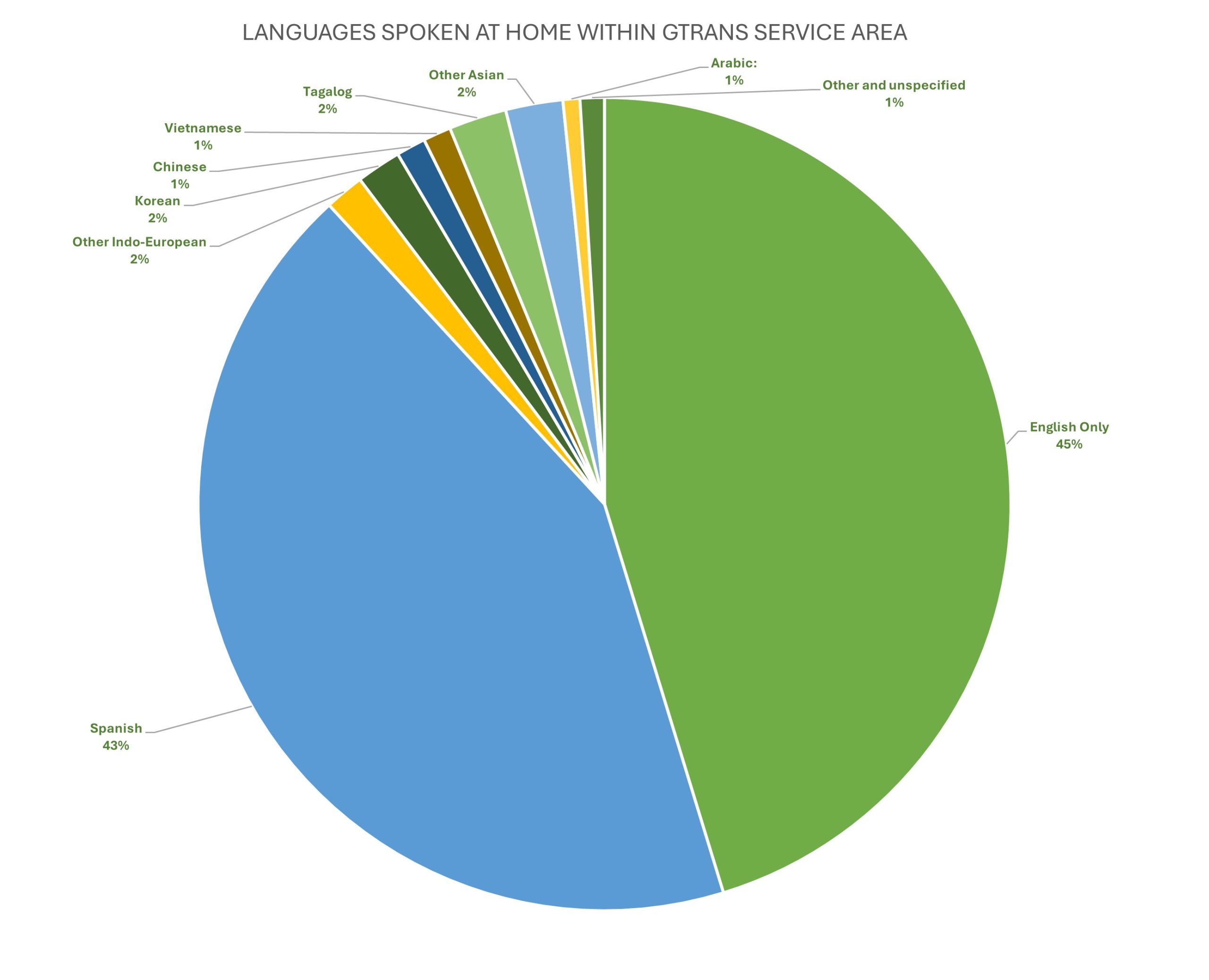
As indicated in Figure 2 above, nearly half of the respondents in GTrans’ service area speak English at home (45 percent). However, there are a significant number (43 percent) of respondents who speak Spanish at home. Of the LEP population, Spanish is the most predominant language spoken by far. Second to Spanish are Tagalog and other Asian and Pacific Islander languages at about four percent, Korean and Other Indo-European languages at about three percent, Chinese, Vietnamese, and Other or Unspecified languages at about two percent. All other languages spoken at home by respondents in GTrans’ service area make up approximately one percent of the total LEP languages spoken at home. Compared to the previous report in 2022, the Spanish language remains the highest spoken other than English within the GTrans area.
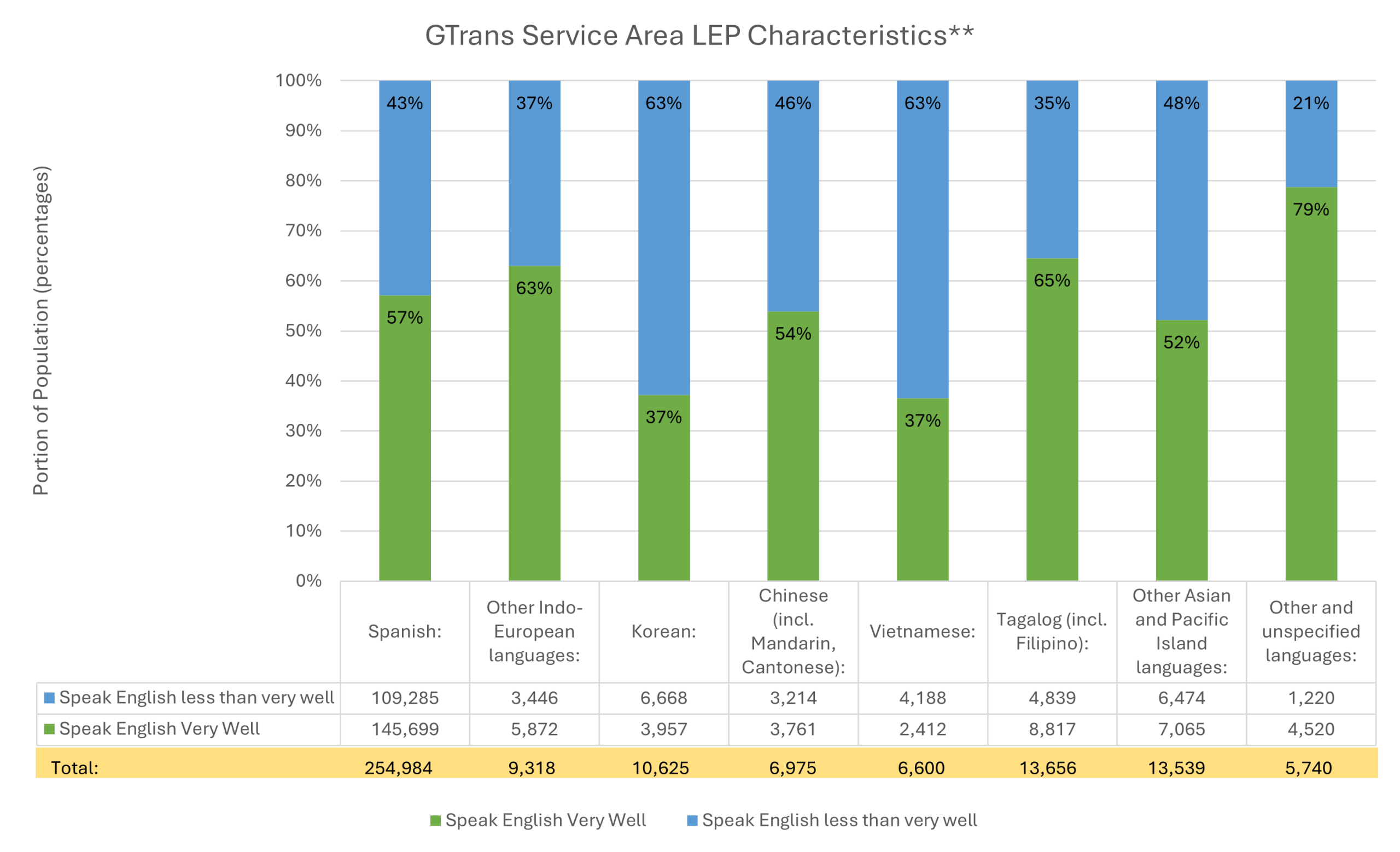
The LEP population is determined by specific categories used by respondents in the ACS. Using LEP classifications of “Very well” and “Less than very well” the number of LEP individuals can be determined. As depicted below in Figure 3 on the following page, approximately 75 percent of the population is classified as speaking English only and speaking English “Very well.” The remaining 25 percent report speaking English “Less than very well.” This is considered the LEP population of GTrans’ service area. Approximately 76 percent of the total LEP population communicates in Spanish, which is by far the main
non-English language spoken in the GTrans service area.
Figure 3 GTrans Service Area LEP Characteristics for populations 1000
Safe Harbor
By further exploring the ACS data, GTrans has determined that there are eight LEP language groups that are required to be analyzed. The U.S. Department of Transportation (USDOT) has adopted the U.S. Department of Justice (USDOJ) Safe Harbor Provision, which outlines circumstances that can provide a “Safe Harbor” for recipients regarding the translation of written materials for LEP populations. The Safe Harbor Provision stipulates that, if a recipient provides written translation of vital documents for each eligible LEP language group that constitutes five percent or 1,000 persons, whichever is less, of the total populations of people eligible to be served or likely to be affected or encountered, then such action will be considered strong evidence of compliance with the recipient’s written language obligations. The GTrans language groups that fall under the Safe Harbor provision are depicted in Figure 3 on the previous page. From the data, Spanish was the largest LEP language group for the GTrans service area with approximately 74 percent of the LEP population. Language groups which exceed 1,000 persons speaking English “Less than very well” are: Korean with approximately 11,436 members of the LEP population Chinese with an LEP population of approximately 7,314, Tagalog with an estimated LEP population of 5,177, Vietnamese with an estimated LEP population of 4,310, Other Asian and Pacific Island languages with an estimated LEP population of 7,549, Other Indo-European languages with an estimated LEP population of 3,903, and Other and unspecified languages with an estimated LEP population of 1,543.
In terms of concentration, GTrans has determined that Spanish-speaking LEP populations are concentrated in GTrans’ service areas around Compton, Inglewood, Lennox, Lynwood, Hawthorne, and Willowbrook, which are within the service areas of Lines 1X, 2, 5, and 7X. Korean-speaking LEP concentrations are mostly in the section of the GTrans service area that occupies Gardena, Carson, and Torrance areas, which are within the service areas of Lines 1X, 2, and 3. Tagalog-speaking LEP populations are concentrated primarily in the GTrans service area which occupies Carson, which is within the service area of Line 2. The concentration of the Vietnamese-speaking LEP population is in the El Camino Village area, which is serviced by Line 1X and 3. The other categories all are dispersed across most of the GTrans lines: The Other Asian and Pacific Island languages are concentrated along the Torrance and Gardena areas, Other Indo-European languages are dispersed amongst the South Bay cities of Torrance, Hawthorne, and Redondo Beach, and Other and unspecified languages are
concentrated within the Gardena and Hawthorne areas.
Although Korean, Chinese, Tagalog, Vietnamese, Other Asian and Pacific Island languages, Other Indo- European languages, and Other and unspecified languages LEP population are above the 1000-person threshold as defined by the DOJ Safe Harbor Provision, they all represent together approximately 7 percent of the LEP population within GTrans Service area.
The GTrans website www.ridegtrans.com has a feature provided by Google that translates the website into over 100 different languages including all of the languages which fall under the Safe Harbor Provision. Written translations for the printed material will be focused on the Spanish LEP language group, which makes up approximately 77.3 percent of the LEP population within GTrans service area. For more on GTrans’ efforts for Safe Harbor languages and its vital documents, please see Factor 4 below.
The Federal guidance also suggests incorporating data that can be obtained through the State Department of Education, which has enrollment data on LEP populations, and the types of languages spoken in the areas throughout which GTrans provides service.
GTrans’ service area encompasses eleven school districts. For this report, not all the schools that represent Los Angeles Unified School were included in the calculation of LEP populations. Rather, just the schools located in census tracks within GTrans’ service area were included, representing a total of 4,088 English learner students grades K-12. Centinela Valley Union High School District includes high schools located in Lawndale, Hawthorne, Lennox, Del Aire, and El Camino Village and has a total of 1,008 English learner students in grades 9-12. Compton Unified School District serves the city of Compton along portions of Paramount and Carson with a total of 4,349 English learner students in grades K-12. El Segundo Unified School District serves the residents of El Segundo and has a total of 77 English learner students in grades K-12. Hawthorne Unified School District serves the residents of Hawthorne and has a total of 1,610 English learner students in grades K-12. Inglewood Unified School District serves students in Inglewood and has a total of 1,758 English learner students in grades K-12. Lawndale Elementary School District serves Lawndale, parts of Hawthorne and the El Camino Village has a total of 1,151 English learner students in grades K-12. Lennox Unified School District serves K-8 students in the Lennox area and has a total of 1,982 English learner students. Redondo Beach Unified School District which serves the areas of both Redondo Beach and Hermosa Beach has a total of 377 English learner students. Torrance Unified School District serves the city of Torrance and has a total of 2,443 English learner students grades K-12. Wiseburn Unified School District, which serves K-8 students in the Hawthorne area, has a total of 349 English learner students.
Figure 4 details the percentage of English learners enrolled at specific GTrans’ service area schools in each of the eleven districts by language spoken, if greater than one percent of the total within the specific district. According to the State of California’s Department of Education, English learners are those who do not speak, read, write, or understand English as a result of English not being their home language. The statistics related to LEP inevitable are in keeping with the census data, in that Spanish is by far the most common language spoken by LEP individuals.
Figure 4 English Learner Students by Languages Greater than 1% of total
| English Learner Students by Languages Greater than 1% of total | ||
|
Number of English Learner students |
% of Language Spoken by English Learner Students in the School
District |
|
| Centinela Valley Union High School District 2023-2024 | ||
| Spanish | 989 | 94.10% |
| Vietnamese | 19 | 1.81% |
| Compton Unified School District 2023-2024 | ||
| Spanish | 4,349 | 99.70% |
| El Segundo Unified School District 2023-2024 | ||
| Spanish | 41 | 54.67% |
| Arabic | 4 | 6.86% |
| Japanese | 4 | 5.33% |
| Khmer (Cambodian) | 3 | 4.00% |
| Mandarin (Putonghua) | 2 | 4.00% |
| Urdu | 3 | 4.00% |
| Portuguese | 3 | 3.92% |
| French | 2 | 2.67% |
| Russian | 2 | 2.67% |
| Thai | 2 | 2.67% |
| Telugu | 2 | 1.96% |
| Hebrew | 1 | 1.33% |
| Indonesian | 1 | 1.33% |
| Marathi | 1 | 1.33% |
| Other Baltic Languages | 1 | 1.33% |
| Other non-English languages | 1 | 1.33% |
| Rumanian | 1 | 1.33% |
| Ukrainian | 1 | 1.33% |
| Undetermined | 1 | 1.33% |
| Vietnamese | 1 | 1.33% |
| Hawthorne Unified School District 2023-2024 | ||
| Spanish | 1,577 | 91.95% |
| Arabic | 33 | 1.92% |
| Inglewood Unified School District 2023-2024 | ||
| Spanish | 1,758 | 96.22% |
| Lawndale Elementary School District 2023-2024 | ||
| Spanish | 1,066 | 88.83% |
| Vietnamese | 58 | 4.83% |
| Arabic | 27 | 2.25% |
| Los Angeles Unified School District 2023-2024 | ||
| Spanish | 4088 | 94.39% |
| Lennox Unified School District 2023-2024 | ||
| Spanish | 1,982 | 99.35% |
| Redondo Beach Unified School District 2023-2024 | ||
| Spanish | 167 | 39.95% |
| Japanese | 59 | 14.11% |
| Russian | 34 | 8.13% |
| Mandarin (Putonghua) | 22 | 5.26% |
| Portuguese | 21 | 5.02% |
| Korean | 18 | 4.31% |
| Arabic | 11 | 2.63% |
| Farsi (Persian) | 10 | 2.39% |
| Vietnamese | 9 | 2.15% |
| Filipino (Pilipino or Tagalog) | 7 | 1.67% |
| French | 7 | 1.67% |
| German | 6 | 1.44% |
| Turkish | 6 | 1.44% |
| Torrance Unified School District 2023-2024 | ||
| Spanish | 894 | 34.14% |
| Japanese | 541 | 20.66% |
| Korean | 274 | 10.46% |
| Arabic | 132 | 5.04% |
| Portuguese | 101 | 3.86% |
| Vietnamese | 81 | 3.09% |
| Mandarin (Putonghua) | 80 | 3.05% |
| Urdu | 74 | 2.83% |
| Other non-English languages | 72 | 2.75% |
| Filipino (Pilipino or Tagalog) | 67 | 2.56% |
| Russian | 45 | 1.72% |
| Farsi (Persian) | 28 | 1.07% |
| Hindi | 27 | 1.03% |
| Telugu | 27 | 1.03% |
| Wiseburn School District 2023-2024 | ||
| Spanish | 167 | 40.05% |
| Japanese | 59 | 14.15% |
| Russian | 6 | 8.15% |
| Mandarin (Putonghua) | 22 | 5.28% |
| Portuguese | 21 | 5.04% |
| Korean | 18 | 4.32% |
| Arabic | 11 | 2.64% |
| Persian (Farsi) | 10 | 2.40% |
| Vietnamese | 9 | 2.16% |
| Filipino (Pilipino or Tagalog) | 7 | 1.68% |
| French | 7 | 1.68% |
| German | 6 | 1.44% |
| Turkish | 6 | 1.44% |
| Grand Total | 19,192 | |
| Data Source: English Learner Students by Language by Grade, California Department of Education. 2023-2024. | ||
| * Information provided in Figure 4 includes only those schools located in census tracts within GTrans’ service area and therefore does not represent district-wide figures. Additional languages are spoken in each district; however, they represent less than 1% of the languages spoken within each district. | ||
The Federal Transit Administration recommends that each agency conduct community outreach to organizations that work with LEP populations. This outreach may provide the agency with information that is not included in the Census, such as information on the specific languages spoken by the LEP populations, population trends, cultural backgrounds of LEP persons, information on what services are most frequently sought by the LEP population, and what will resonate equally among all nationalities and subcultures within the GTrans service area.
GTrans continues to be dedicated to reaching the various demographics that they serve. To get an understanding of the various needs of the community, GTrans participates in diverse community events to best reach LEP individuals and receive feedback. While participating in events, GTrans discusses its Clean Air Initiatives, distributes department information, showcases services, including the new on-demand shared-ride services, promotes services to potential new ridership, promotes the GoPass Fareless Program for students, promotes sustainability efforts of the department, provides information on how to ride the bus, public safety concerns, senior TAP card applications, and receives valuable feedback from customers and non-customers. Since its 2022 Title VI report, GTrans had the opportunity to share the aforementioned information at a variety of events. A sample of these events is listed on the following page:
| Clean Air Day | City of Gardena’s
Harvest Festival |
City of Gardena Fall Carnival | City of Gardena’s Too Cute to Spook Halloween Event |
| LABFive Trunk or Treat Event | City of Gardena Veterans Day Service | Martin Luther King Jr. Parade | City of Gardena Community Meetings |
| It Takes a Village Community Fair | South Bay Cities Council of Governments 23rd Annual General Assembly | Gardena High School Resource Fair | United: A Community Celebration |
| Blueprint for Success Youth & Adult Job Fair | City of Hawthorne Business Expo | City of Gardena’s Cinco
De Mayo Parade and Festival |
City of Gardena’s Fun
in the Sun Senior Day Event |
| City of Gardena’s Kids
to Park Day |
Bring it on the Blvd Downtown Street Fair
event |
City of Gardena’s
National Night Out |
Bolt Powered by GTrans ribbon-cutting
ceremony |
Based on the interactions between GTrans staff and the aforementioned community groups and events, the LEP language most encountered is Spanish. Recognizing that demographics and languages are shifting all the time, GTrans will continue to work with these and other community groups to continue to gain experience and knowledge about its LEP population.
Factor 2: The Frequency with which LEP Individuals Come into Contact with Your Programs, Activities, and Services
What the Guidance Says:
“Recipients should assess, as accurately as possible, the frequency with which they have or should have contact with the LEP individuals from different language groups seeking assistance, as the more frequent the contact, the more likely enhanced language services will be needed”
GTrans recently reviewed the frequency with which staff and drivers have or could have contact with LEP persons. GTrans conducted a recent survey of bus operators and frontline staff, including the front office Customer Service who handles all calls and visits, and Staff who often interact with the community and passengers. Of those surveyed, 52.5 percent indicated they interacted with more than one individual with limited English proficiency during a typical shift.
Approximately 70 percent of the respondents indicated that the primary LEP language encountered was Spanish. Roughly, 75 percent of the respondents indicated that they most frequently encounter LEP customers along Line 2, which is GTrans’ highest ridership line. There have only been a few requests made to the operators and frontline staff for language translation of public information, with 65 percent indicating that passengers have not requested translated materials.
Here are additional relevant activities and services provided by GTrans during which LEP contact is made:
- Fixed Route transit services on 6 routes
- In person at GTrans Customer Service Desk
- City of Gardena Phone Tree providing names, phone numbers, and languages of certified employees in the City that can assist with translation or interpretation
- Bolt Powered by GTrans on-demand shared-ride service within the City of Gardena, Hawthorne and portions of LA County
- GTrans outreach events and information booths
- Bus Operators and their Supervisory Team interact with LEP persons daily in the field
- GTrans Website with Google Translate feature which translates the website into over 100 different languages
- Schedules, brochures, and bus signage provided in English and Spanish
- GTrans social media accounts include Facebook, and Instagram
- Outreach with local schools regarding access to services
In an effort to explore the needs of LEP communities within the GTrans service area, staff surveyed local organizations including the El Camino College, Southwest College, South Bay Adult School, St. Anthony of Padia Catholic Church, The Potter’s House Church of Los Angeles, Gardena Valley Baptist Church, Trinity Lutheran Church & Schools, Angeles Community Health Center, Massao W. Satow Library, Gardena Mayme Dear Library, Carson One-Stop Community Center, Gardena One-Stop Employment Center, Hawthorne Senior Center, A C Bilbrew Library, and Compton Library. The purpose of this dialogue was to understand further the extent of the LEP population in GTrans’ service area, as well as the needs of the community. The discussions resulted in confirmation that Spanish is the largest spoken language amongst the LEP population. Other languages common within those organizations included Japanese, Chinese, and Tagalog, which represent a small sector of the overall LEP population in the GTrans service areas. From our conversations with these organizations, we learned that the seniors make up a large amount of the LEP population and prefer communication like phone calls, printed newsletters, and phone calls.
While other languages are not required, GTrans collaboratively works with the aforementioned organizations on an as-needed basis for materials in languages other than the majority.
Factor 3: The importance to LEP Persons of Your Program, Activities, and Services
What the Guidance Says:
“The more important the activity, information, service, or program, or the greater the possible consequences of the contact to the LEP individuals, the more likely language services are needed”
Through input from community organizations and interactions with riders, GTrans has determined its most crucial services to be its fixed route and paratransit services. Related to this service, GTrans provides vital documents, without which a person would be unable to access services. GTrans’ vital documents are as follows:
Vital Documents
GTrans Route and Schedule Guide Bolt Powered by GTrans Information
Title VI Notice, Title VI Plan, and Complaint Procedures Language Assistance Plan
Public Notices to Change in Service
ADA Reasonable Accommodation Request Form PTASP Safety Plan
Factor 4: The Resources Available to the Recipient and Cost
What the Guidance Says:
“A recipient’s level of resources and the costs imposed may have an impact on the nature of the
steps it should take in providing meaningful access for LEP persons”
As a small transit operator, GTrans has limited resources but manages to stretch this limited budget through cost-effective and efficient measures that benefit not only GTrans’ LEP customers but all customers. Currently, GTrans practices several measures in support of assisting the LEP population. These efforts include:
- There is staff within the Transportation Department and throughout the City of Gardena who are on the Bilingual List of Translators and eligible for Bilingual Bonus Pay. Eligible employees receive $31 per pay period. As of May 2025, the City of Gardena has 46 employees that can translate Tagalog, Spanish, Japanese, Vietnamese, or Korean. GTrans, specifically, has 17 employees that receive this compensation for a FY2025 budgeted cost of $16,904.
- GTrans’ Route and Schedule Guide is printed in both English and Spanish, providing maps and timetables in addition to offering customers important information about how to ride the bus, critical information on fares and passes, information on Bolt, etc. There is only minimal incremental cost for this guide to include Spanish translation, as in-house staff provides the translation copy. The cost to print the guides in total is roughly $9,500
- GTrans’ website uses Google Translate feature to support over 100 languages for immediatetranslation. This feature is free for GTrans to use on its website.
- GTrans’ non-bilingual bus operators ask other customers on board for translation assistance when they are either unable to understand or communicate with an LEP person or are not near the GTrans’ staffed customer service center. If still unable to provide assistance, GTrans operators are instructed to contact Dispatch for assistance. This is at no additional cost.
- Brochures and other materials including signage and information cards for the bus are printed in both English and Spanish. This amounts to approximately $11,000 per year.
- Public outreach team and events are held throughout the year to provide the public, which includes the LEP population, with information and These outreach events are already in the budget for outreach; however, the staff ensures there are Spanish-speaking employees available to assist with GTrans’ Spanish-speaking customers. This additional cost is approximately $10,000 per year.
GTrans will continue to translate its vital documents such as the Route and Schedule Guide, Bolt Powered by GTrans Information, Title VI Notice, Title VI Plan and Complaint Procedures, Language Assistance Plan, Public Notices to Change in Service, Reasonable Accommodation Request Form, and the PTASP Safety Plan through Google Translate on the GTrans website and use certified translators when needed. GTrans will also continue to use its in-house multilingual staff, citywide Bilingual List of Translators, and Google Translate to translate for eligible LEP language groups.
Conclusion:
GTrans has developed several methods to guarantee that those who rely on public transit and are limited English speakers are able to receive critical information. The availability of the resources outlined in the four-factor analysis has greatly helped in providing critical information to GTrans’ LEP population. As shown in the review of U.S. Census information, GTrans can provide services to most of its service area without any additional effort. GTrans will continue to make efforts to ensure that LEP individuals do not feel unable to utilize the services provided by the city.
Language Assistance Plan
Introduction
U.S. Department of Transportation (DOT) Limited English plan (LEP) guidance recommends that GTrans, as a recipient of federal funds, develop an implication plan to address the needs of the LEP population it serves. GTrans has developed this Limited English Proficiency Plan to help identify reasonable steps for providing language assistance to persons with Limited English Proficiency (LEP) who wish to access services provided. This plan outlines how to identify a person who may need language assistance, the language assistive measures, training staff, providing notice to LEP persons, and monitoring and updating the LEP plan.
Element 1: Identifying LEP individuals Who Need Language Assistance
What the Guidance Says:
“There should be an assessment of the number or proportion of LEP individuals eligible to be served or encountered and the frequency of encounters pursuant to the first two factors in the four-factor analysis”
As part of the four-factor analysis, GTrans’ used ACS data to determine the breakdown of LEP individuals located within its service area. This was executed using the analysis of 206 Census tracts, and approximately 714,006 residents.
The data showed some very clear trends within GTrans’ service area. Approximately 56% of the residents in the service area speak a language other than English at home. Of the total service area population, 75.5% identified themselves as speaking English only or “Very well.” This figure includes the 44.3% of those who identify themselves as speaking only English, but also the populations which speak other languages and speak English “Very well”. GTrans also determined that 24.5% of GTrans service area population can be classified as LEP, and of that population 74.1% spoke Spanish.
Spanish is the clear and overwhelming LEP language to be addressed in the GTrans’ service area. In accordance with the USDOJ’s Safe Harbor Provision, Korean, Chinese, Tagalog, Vietnamese, Arabic, Other Asian and Pacific Island languages, Other Indo-European languages, and Other and unspecified languages LEP populations are emerging in GTrans’ service area, with concentrations seen in specific areas. As indicated in Factor 1, GTrans regularly encounters LEP individuals throughout its day-to-day operations. By far the most common language group encountered by GTrans, outside of English is Spanish.
Element 2: Language Assistance Measures
What the Guidance Says:
“An effective LEP Plan would likely include information about the ways in which language
assistance will be provided”
GTrans will strive to offer the following measures to LEP individuals, that is, persons who speak English
“Less than very well.”
- GTrans’ Title VI Policy and GTrans staff will take reasonable steps to provide the opportunity for
meaningful access to LEP clients who have difficulty communicating in English.
- If a client asks for language assistance and GTrans determines that the client is an LEP person and that language assistance is necessary to provide meaningful access, reasonable efforts will be made to provide meaningful access, reasonable efforts will be made to provide free language assistance. If reasonably possible, GTrans will provide language assistance in the LEP client’s preferred language. GTrans has the discretion to determine whether language assistance is needed, and if so, the type of language assistance necessary to provide meaningful access.
- GTrans will periodically assess client needs for language assistance based on requests for interpreters and/or translations, as well as the literacy skills of the clients.
- When an interpreter is needed, in person or on the telephone, staff will attempt to determine what language is required and then access language assistance at one or more of the available resources identified on the next page.
Element 3: Training Staff
What the Guidance Says:
“Staff members should know about their obligations to provide meaningful access to information and services for LEP persons, and all employees in public contact positions should be properly trained. An effective LEP plan would likely include training to ensure that:
- Staff knows about LEP policies and procedures
- Staff having contact with the public (or those in recipient’s custody) is trained to work effectively with in person and telephone interpreters”
The following training will be provided to GTrans staff
- Information on the Title VI Policy and LEP responsibilities
- Description of language assistance services offered to the public
- Process for assisting LEP customers when translation is requested
- How to handle potential Title VI/LEP complaints
Element 4: Providing Notice to LEP Persons
What the Guidance Says:
“Once an agency has decided, based in the four-factors, that it will provide language services, it is important that the recipient notify LEP persons of service es available free of charge. Recipients
should provide this notice in languages LEP person would understand.”
GTrans currently provides most of its public printed material about service in both English and Spanish including the Route and Schedule Guide and bus signage. Staff members throughout GTrans, who are bilingual in English and Spanish, are available to assist customers as needed. Furthermore, the website offers a feature from Google Translate which automatically can translate the website into over 100 different languages.
Translation of Documents
- In those cases where the need arises for LEP outreach, GTrans will consider the following options:
- When staff prepares a document, or schedules a meeting, for which the target audience is expected to include LEP individuals, then documents, meeting notices, flyers, and agendas will be printed in an alternative language for the known LEP population
- Bus schedules, maps, and other transit publications will be made available in an alternative language for the known LEP population through the GTrans website using the Google translate feature
Formal Interpreters
- When necessary to provide meaningful service to LEP clients, GTrans will provide qualified interpreters upon request, including any bilingual staff of the City of Gardena, if available. The City of Gardena has identified all City staff who speak languages other than At important stages that require one-on-one contact, written translations and verbal interpretation services will be provided consistent with the four-factor analysis used earlier.
- GTrans may require a formal interpreter to certify to the following:
- The interpreter understood the matter communicated and rendered a competent interpretation
- The interpreter will maintain private information, non-public data will not be disclosed without written authorization from the client
- Bilingual City Employees, when available, can provide limited assistance to GTrans staff and LEP clients as part of their regular job duties
Informal Interpreters
- Informal interpreters may include the family members, friends, legal guardians, service representatives or advocates of the LEP client. GTrans staff will determine whether it is appropriate to rely on informal interpreters, depending on the circumstances and subject matter of the communication. However, in many circumstances, informal interpreters, especially children, are not competent to provide quality and accurate interpretations. There may be issues of confidentiality, competency, or conflict of interest.
- An LEP person, may use an informal interpreter of their own choosing and at their expense, either in place of or as a supplement to the free language assistance offered by GTrans. If possible, GTrans should accommodate an LEP client’s request to use an informal interpreter in place of a formal interpreter.
- If an LEP client prefers an informal interpreter after GTrans has offered free interpreter services, the informal interpreter may interpret.
- If an LEP client wants to use their own informal interpreter, GTrans serves the right to also have a formal interpreter present.
Element 5: Monitoring and Updating LEP Plan
What the Guidance says:
“Evaluation can help you track your outreach efforts, discover dissemination problems early, make corrections, and find out whether your language services have impacted your ridership and/or relations with local immigrant communities”
GTrans will update the LEP Plan as required by U.S. DOT every 3 years or when significant changes are required. GTrans intends to explore additional improvements that may be developed as a result of an ongoing dialog with the LEP community and changes to the demographics of the service area.
Dissemination of the GTrans LEP Plan
A link to the GTrans Title VI Plan and the LEP Plan will be included on the GTrans website,
http://ridegtrans.com/contact/title-vi-report/ and at http://ridegtrans.com/contact/lep-plan/
Any person or agency with internet access will be able to access and download the plan from the GTrans website. Alternatively, any person or agency may request a copy of the plan via telephone, fax, mail, or in person, and shall be provided a copy of the plan at no cost. LEP individuals may request a copy of the plan in translation which GTrans will provide, if feasible.
Questions or comments regarding the LEP Plan may be submitted to GTrans in person at 13999 S. Western Ave., Gardena, CA 90249, through phone (310) 965-8888, or email at titlevi@gardenabus.com.