Title VI Report
View the Title VI Complaint Procedure
View the Title VI Complaint Form
2025 Title VI Plan
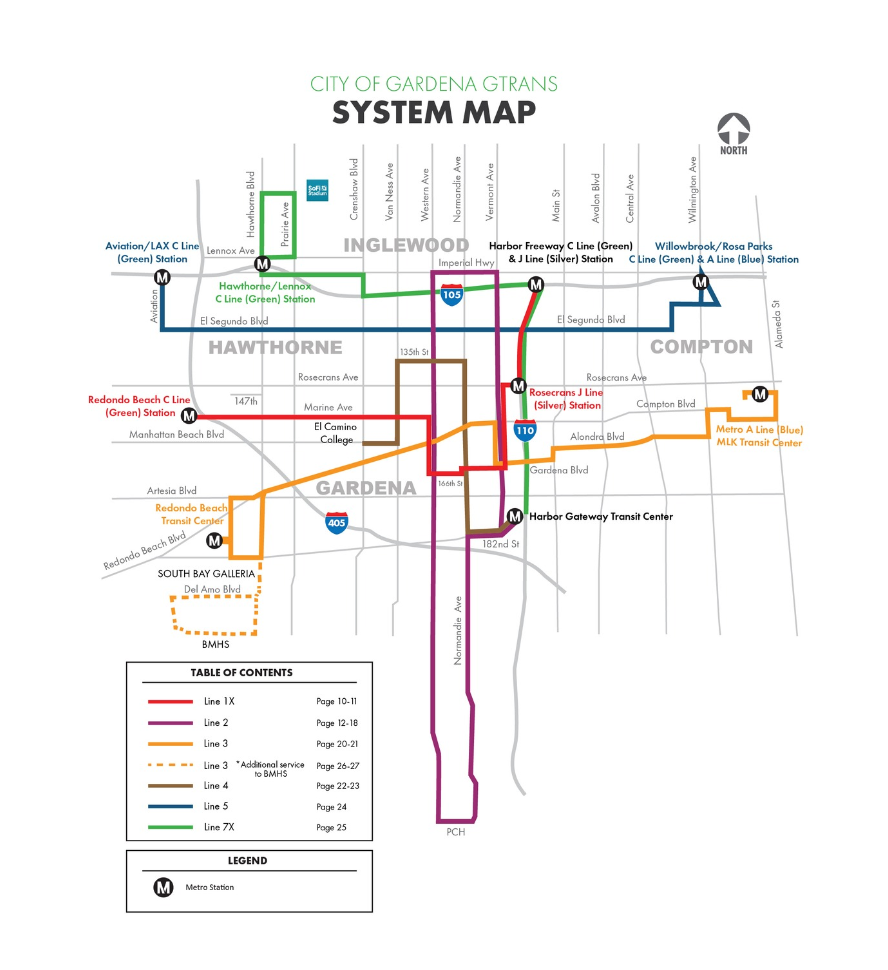
TABLE OF CONTENTS
- OVERVIEW
- Title VI of the Civil Rights Act of 1964
- Agency Overview
- Services Provided
- GENERAL REPORTING REQUIREMENTS
- Civil Rights Notice to the Public
- Procedures for Reviewing a Title VI Complaint
- Title VI Investigations, Complaints and Lawsuits
- Public Engagement Process
- Language Assistance Plan
- Membership of Non-Elected Committees and Councils
- Monitoring Subrecipients and Contractors
- Fixed Facility Impact Analysis
- Governing Body Approval of Title VI Plan
- PROGRAM SPECIFIC REQUIREMENTS
- System-Wide Service Standards
- System-Wide Service Policies
- Fare and Service Equity Analyses
- APPENDICES
- APPENDIX A: Title VI Complaint Form and Procedures for Reviewing Complaints
- APPENDIX B: Title VI Investigations, Complaints and Lawsuits
- APPENDIC C: Public Participation Process for Fare and Four-Factor Analysis
- APPENDIX D: GTrans’ Language Assistance Plan and Four-Factor Analysis
- APPENDIX E: Gardena City Council Approval of 2022 Title VI Program
- APPENDIX F: GTrans Bus Stop Policy
1. OVERVIEW
A. Title VI of the Civil Rights Act of 1964
The Civil Rights Act of 1964 prohibits discrimination on the basis of race, color, or national origin. Title VI of the Act states that “No person in the United States shall, on the grounds of race, color, or national origin, be excluded from participation in, be denied the benefits of, or be subjected to discrimination under any program or activity receiving federal financial assistance.”
To achieve this purpose, each federal department and agency, which provides financial assistance for any program or activity, is authorized and directed by U.S. Department of Justice (DOJ) to put into effect provisions of Title VI for each program or activity by issuing applicable rules, regulations, or requirements.
In this regard, applicants, recipients, and sub-recipients of Federal Transit Administration (FTA) assistance are responsible for distributing transit services and related benefits in a manner consistent with Title VI. Title VI requires recipients of federal assistance to monitor and evaluate federally assisted programs for compliance. The FTA is responsible for ensuring compliance of transit agencies receiving federal assistance. FTA Circular 4702.1B describes the monitoring methodology used by recipients. Transit providers must conduct periodic assessments to determine whether the transit service provided to minority communities and minority users is consistent with the objectives cited in this circular. The City of Gardena’s GTrans receives federal assistance for the provision of public transit services and therefore complies with the Civil Rights Act of 1964 and the provisions of Title VI.
All transit providers—whether direct recipients, primary recipients, or subrecipients—that receive financial assistance from FTA are also responsible for following the general requirements in FTA 47021.B Chapter IV, which are scaled based on the size of the fixed route transit provider.
| Requirements | Transit Providers that Operate Fixed Route Service | Transit Providers that Operate 50 or more fixed route vehicles in peak service and are located in a UZA of 200,000 or more in population |
|---|---|---|
| Set system-wide standards and policies | Required | Required |
| Collect and report data | Not required | Required:
|
| Evaluate service and fare equity changes | Not required | Required |
| Monitor transit service | Not required | Required |
B. Agency Overview
The City of Gardena is located in the South Bay subregion of Los Angeles County, approximately 12 miles from the downtown Central Business District (CBD) of Los Angeles. Gardena is bounded on the north and west by unincorporated areas of Los Angeles County, as well as the City of Hawthorne and on the south and east by the cities of Los Angeles and Torrance. The City of Gardena was incorporated in 1930 and is governed by a five-member City Council, one of whom is the Mayor and presiding officer. The City Manager, appointed by the Council, administers the day-to-day business of the City.
The City’s Transportation Department (GTrans) inaugurated service in 1940 and for over 82 years has been one of three municipal transit operators serving the South Bay subregion of Los Angeles County. GTrans provides fixed-route bus service using a fleet of 52 buses deployed over six routes. Prior to the COVID-19 pandemic, GTrans boarded nearly three million customers annually on the system.
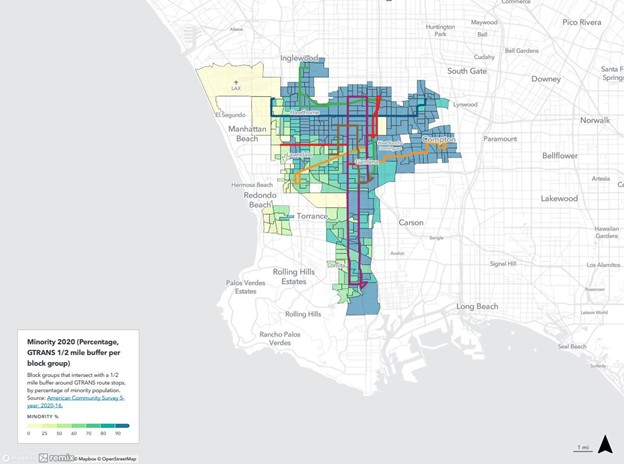
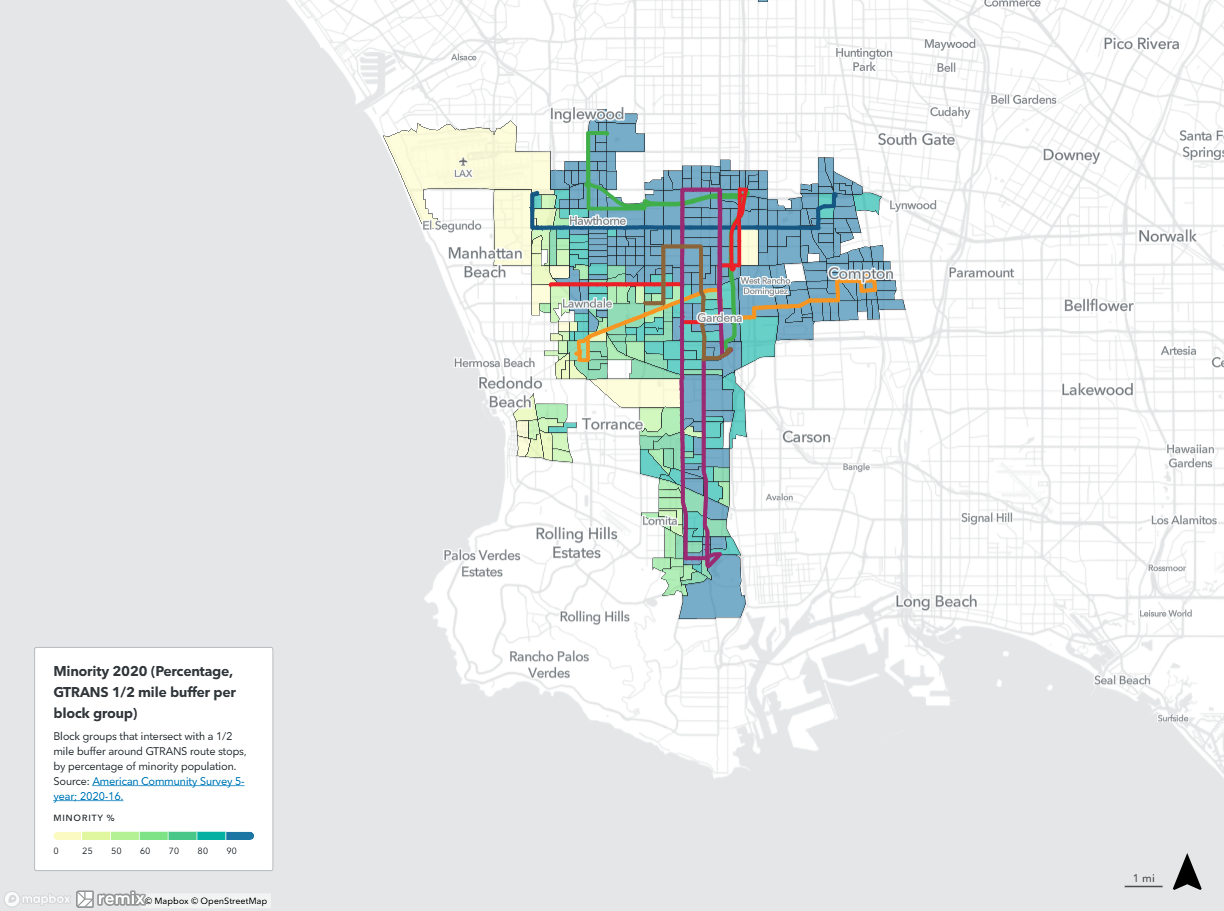
As shown in Exhibit 1, the GTrans service area is quite racially diverse. According to the 2020 American Community Survey, roughly 89 percent of GTrans’ service area residents are considered a minority. The minority population includes designations of Hispanic or Latino, African American, Asian, Indian and Alaska Natives, Pacific Islander, or other non-white races including persons of two or more races.
Service is deployed to the City of Gardena and throughout the adjacent communities of Torrance, Redondo Beach, Carson, Compton, City of Los Angeles, Hawthorne, Lawndale, Inglewood, and certain unincorporated areas of Los Angeles County. GTrans also serves downtown Los Angeles and interfaces at several points with Los Angeles County Metropolitan Transportation Authority’s (Metro) A (Blue) and C (Green) Line light rail services, J (Silver) Line at Harbor Gateway Transit Center, and Metro bus service. GTrans also connects with Torrance Transit, Beach Cities Transit, Lawndale Beat, the Los Angeles Department of Transportation (LADOT), and the City of Compton’s Renaissance Transit. More than two-thirds of the GTrans service area lies outside the City of Gardena boundaries. Customers may transfer between many of these services with a special interagency transfer or the regional LA County monthly EZ Transit Pass.
GTrans also operates a demand-response transit service for its elderly and disabled residents called Gardena Special Transit. In addition to the City of Gardena residents, GTrans provides this service on a consolidated basis to the elderly and disabled residents of Hawthorne and the Los Angeles County unincorporated areas of Del Aire and Alondra Park. This service is provided in addition to that which is provided by Access Services, Inc., the Los Angeles County complementary paratransit service mandated by the Americans with Disabilities Act of 1990 (ADA).
GTrans operates out of its main Administrative, Operations, and Maintenance facility located at 13999 S. Western Avenue in Gardena.
GTrans’ fixed-route revenue fleet consists of 66 vehicles: 52, 40-foot buses, and fourteen contingency buses. GTrans also operates eight Special Transit vehicles, including four vans and four cutaway vehicles. GTrans’ active fixed-route fleet consists of gasoline hybrid electric buses (model years 2005, 2009 and 2010), electric buses (both battery-electric conversion and traditional electric buses), and CNG buses.
GTrans has adopted an alternative fuel strategy for the immediate future to include 80 percent Compressed Natural Gas (CNG) and 20 percent zero-emission buses. GTrans deployed its first order of 18 CNG buses, and is awaiting delivery of another 21, along with an additional seven zero-emission battery electric buses that will replace all of the gasoline hybrid electric buses in its fleet. All buses use low-floor, curb-level technology, and all are fully ADA accessible. Fixed-route buses can accommodate up to three bikes.
Exhibit I GTrans Bus Lines Title VI Census Tracts in Service Area, Minorities Per Census Tract
C. Services Provided
Fixed Route Bus Service
Since the 2022 report, GTrans has seen an increase in patrons since the COVID-19 pandemic but has yet to fully recover pre-pandemic ridership numbers. Fixed route service is provided with an active fleet of 51 buses distributed over 6 routes, with a peak requirement of 26 buses. As such, GTrans falls under the Title VI requirements of Transit Providers that Operate Fixed Route Service.
Effective January 5, 2025, GTrans adopted system-wide service changes to meet customer demand and improve service reliability.
Line 1 – Trips to Downtown L.A. eliminated:
GTrans eliminated all weekday service to Downtown L.A. and permanently adopted the current modified weekend frequency and routing, with improvements to the schedule. The updated schedule runs from Monday to Sunday from Redondo Beach C Line Station to Harbor Freeway C Line and J Line Station.
The zone fares were also eliminated.
Line 2 – Adjustments to Weekend running times:
GTrans made minor schedule adjustments to Line 2 during weekend peak periods to improve on-time performance and overall service.
Line 3 – Adjustments to PM running times:
GTrans adopted minor schedule adjustments to Line 3 service heading Eastbound during the PM peak periods to improve on-time performance and overall service.
Line 4 – Permanent reduction to service:
GTrans permanently reduced service to the morning and afternoon peak periods only.
Line 5 – Expanded service to operate on weekends:
GTrans improved peak frequency to 30 minutes on the current weekday schedule, along with adding a new weekend service at a peak frequency of 30 minutes, between the Metro Willowbrook/ Rosa Parks Station in Compton and the Aviation/LAX Station in El Segundo. With the addition of weekend service, GTrans aims to provide more connections to the Automated People Mover and LAX Transit Center when operational. Once the new LAX/Metro Transit Center Station opens, the Aviation/LAX station will no longer serve as the end of the line. Final connections will be made at the new LAX/Metro Transit Center.
Service operates weekdays throughout the fixed-route system from 4:25 a.m. to 10:01 p.m., and on six routes on weekends from 4:44 a.m. to 9:38 p.m.
Bolt Powered by GTrans On-Demand Shared-Ride Service
GTrans also operates an on-demand shared-ride service using nine accessible cutaway and minivan vehicles for the general public, registered senior citizens, and persons with disabilities. Bolt’s general public on-demand service is for rides within the boundaries of Gardena. Bolt for paratransit customers includes residents of Gardena, Hawthorne, and unincorporated areas of Alondra Park and Del Aire in Los Angeles County.
Residents wishing to use the Bolt on-demand paratransit service can apply for a membership card at the Gardena Senior Citizens Bureau or Hawthorne Memorial Center. Once a Senior or Paratransit rider is registered in the system, they may book a ride through Bolt Paratransit dispatch, the Gardena Senior Citizens Bureau, the Bolt website, or the Bolt Powered by GTrans App. Arrangements must be made at least 48 hours in advance. The service normally would operate Monday to Friday 6:00 a.m. – 9:00 p.m., Saturdays from 10:00 a.m. – 9:00 p.m., and Sunday and Holiday service 8:00 a.m. – 2:30 p.m.
The regular fare for the general public on-demand service is $2.00 per ride. For Bolt on-demand paratransit, the one-way fare is $0.75. Riders from the Gardena Senior Citizens Bureau may purchase S.S.I. tickets for $0.35 cents each, and the City of Hawthorne sells dial-a-ride tokens to its residents for $0.75 cents one-way. An aide assisting a passenger with disabilities rides free of charge; however, the person requiring the aide must have the ID card that specifies the need for the aide service.
2. GENERAL REPORTING REQUIREMENTS
A. Civil Rights Notice to the Public
Part of GTrans’ Title VI responsibilities is to inform the public of its obligations through a public notice that details GTrans’ Title VI complaint procedures. The following notice is posted in GTrans’ Route and Schedule Guide, on the GTrans website www.RideGTrans.com, onboard GTrans buses and in the lobby of GTrans’ Administrative, Operations and Maintenance headquarters, located at 13999 S. Western Avenue in Gardena:
Title VI Civil Rights
The City of Gardena’s GTrans is committed to ensuring that no person is excluded from participation in, or denied the benefits of its services on the basis of race, color, national origin, as protected by Title VI of the Civil Rights Act of 1964, as amended.
No person or group of persons will be discriminated against with regard to fares, routing, scheduling, or quality of transportation service that GTrans furnishes, on the basis of race, color, or national origin. In addition, the frequency of service, age and quality of GTrans vehicles assigned to routes, and location of routes will not be determined on the basis of race, color, or national origin.
If you believe you have been discriminated against, you may file a signed, written complaint within one hundred and eighty (180) days of the alleged discrimination date. The complaint should include the following information:
1. Your name, address, and how to contact you (i.e., telephone number, email address, etc.)
2. How, when, where, and why you believe you were discriminated against. Include the location, names and contact information of any witnesses.
The complaint may be filed in writing with GTrans Customer Service at:
Attn: Deputy City Manager
City of Gardena Department of Transportation
13999 S. Western Avenue
Gardena, CA 90249
Complaint forms can be obtained at GTrans’ website:
https://ridegtrans.com/contact/title-vi-complaint-form/
To request additional information regarding Title VI, please call 310-965-8888 or email titlevi@gardenabus.com.
B. Procedures for Reviewing a Title VI Complaint
The following is a summary of the procedures GTrans uses for the investigation and resolution of the formal Title VI complaints. Please see Appendix A for GTrans’ Title VI Complaint Form, the formal complaint procedures provided to the public, and GTrans’ internal procedures for Title VI complaint handling.
GTrans staff will adhere to the following internal procedures when investigating and resolving Title VI complaints:
- GTrans staff will accept either the formal Title VI Complaint form or if a customer calls in to complain about discrimination, staff will submit the complaint on his/her behalf through the Trapeze COM system and identify it as a potential Title VI complaint. For either method or receipt, staff will proceed in accordance with the process below.
- Once a Title VI complaint is received, GTrans staff will contact the complainant to obtain additional details and information that will assist with the investigation. Department staff will meet with any complainant at their request.
- Staff will attempt to obtain additional internal documentation, which may assist in the investigation, including on-board video camera footage, statements from GTrans personnel, etc.
- GTrans has 90 days to investigate the complaint. If more information is needed to resolve the case, GTrans may contact the complainant via phone or letter. The complainant has 15 business days from the date of the call or letter to send requested information to the personnel assigned to investigate the complaint. If the investigator is not contacted by the complainant or GTrans does not receive the additional information within 60 business days, GTrans can administratively close the case. A case can be administratively closed if the complainant no longer wishes to pursue their case.
- After the complaint is reviewed and a determination is made, GTrans will send a closure letter or a letter of finding (LOF) to the complainant. A closure letter summarizes the allegations and states that there was not a Title VI violation and that the case will be closed. A LOF summarizes the allegations and the interviews regarding the alleged incident, and explains how the situation will be addressed. If the complainant wishes to appeal the decision, he/she has 90 business days after the date of the LOF to do so.
- A detailed record of all Title VI complaints and the City’s response will be kept on file for a minimum of five years.
C. Title VI Investigations, Complaints and Lawsuits
GTrans has had no lawsuits and four complaints alleging discrimination under Title VI since the submittal of its 2022 Title VI Program. Of the four complaints alleging discrimination, none were substantiated, and GTrans is not aware of any formal Title VI complaints filed with the FTA.
For a summary listing of the Title VI Investigations, Complaints, and Lawsuits please see Appendix B.
D. Public Engagement Process
The City of Gardena’s GTrans continually monitors and considers the impact of various service decisions
as they relate to the community and customers using the service.
As required by FTA Circular 9030.1E, Chapter VI Program Management and Administrative Requirements, the City of Gardena’s GTrans must establish a process to solicit and consider public comment before raising fares or implementing a major reduction of transit services. The policy should provide an opportunity for a public hearing or public meetings for any fare increase or major service reduction and should describe how the recipient will conduct such meetings and how the recipient will consider the result of such meetings in the process of changing fares and service.
The purpose of GTrans’ Public Participation Process is to promote public involvement in transit planning decision-making activities. This plan establishes formal procedures that allow for, encourage, and monitor public participation within the GTrans service area, including, but not limited to, minority individuals, persons with Limited English Proficiency (LEP), and low-income populations.
GTrans continues to be dedicated to reaching the various demographics that they serve. To get an understanding of the various needs of the community, GTrans participates in diverse community events to best reach LEP individuals and receive feedback. While participating in events, GTrans discusses its Clean Air Initiatives, distributes department information, showcases services, including the new on-demand shared-ride services, promotes services to potential new ridership, promotes the GoPass Fareless Program for students, promotes sustainability efforts of the department, provides information on how to ride the bus, public safety concerns, senior TAP card applications, and receives valuable feedback from customers and non-customers. Since its 2022 Title VI report, GTrans had the opportunity to share the aforementioned information at a variety of events. A sample of these events are listed below:
|
Clean Air Day |
City of Gardena’s Harvest Festival |
City of Gardena Fall Carnival |
City of Gardena’s Too Cute to Spook Halloween Event |
|
LABFive Trunk or Treat Event |
City of Gardena Veterans Day Service |
Martin Luther King Jr. Parade |
City of Gardena Community Meetings |
|
It Takes a Village Community Fair |
South Bay Cities Council of Governments 23rd Annual General Assembly |
Gardena High School Resource Fair |
United: A Community Celebration |
|
Blueprint for Success Youth & Adult Job Fair |
City of Hawthorne Business Expo |
City of Gardena’s Cinco De Mayo Parade and Festival |
City of Gardena’s Fun in the Sun Senior Day Event |
|
City of Gardena’s Kids to Park Day |
Bring it on the Blvd Downtown Street Fair event |
City of Gardena’s National Night Out |
Bolt Powered by GTrans ribbon-cutting ceremony |
Please see GTrans’ adopted Public Participation Process for Fare and Service Changes in Appendix C.
E. Language Assistance Plan
Individuals who have a limited ability to read, write, speak, or understand English are considered persons with Limited English Proficiency. In Los Angeles County, according to the U.S. Census records, approximately one-quarter of the County’s residents would describe themselves as being able to communicate in English less than “very well.”
Title VI prohibits conduct that has a disproportionate effect on LEP persons because such conduct constitutes discrimination based upon national origin. In conjunction with the development of its 2025 Title VI Program, GTrans updated its Language Assistance Plan and four-factor analysis of services provided to the LEP population.
For a copy of GTrans’ Language Assistance Plan and Four Factor Analysis, please see Appendix D.
F. Membership of Non-Elected Committees and Councils
GTrans does not select membership to any transit-related, non-elected planning boards, advisory councils, or committees, or similar bodies.
G. Monitoring of Subrecipients and Contractors
For the reporting period, GTrans did not have any subrecipients that received federal financial assistance from the FTA.
H. Fixed Facility Impact Analysis
GTrans has not constructed any new fixed facilities since the submission of its 2025 Title VI Program and thus has not performed a fixed facility impact analysis.
I. City Council Approval of Title VI Program
The GTrans 2025 Title VI Program received governing body approval by the City of Gardena’s City Council on July 8, 2025. Please see Appendix E for a copy of the agenda and minutes.
3. Program Specific Requirements
A. System Wide-Service Standards
Service performance standards are necessary to ensure that all services are contributing positively to the transit network and the overall financial stability of GTrans. Performance should be measured regularly to identify trends over time and to allow prompt changes to be enacted if necessary. GTrans has adopted quantitative system-wide service standards for its fixed route services. These standards, which are summarized below, were developed and implemented to better help GTrans achieve equity for all its transit customers in service design and operations decisions.
Performance standards help ensure that GTrans services are equitably provided, useful to customers, and cost-effective for the organization.
Passenger Load
Passenger load is the ratio of passengers on the vehicle to the number of seats on the bus. If the passenger load is high, resulting in overcrowded conditions, additional service may be needed to address the issue. GTrans measures the vehicle load at the maximum load point on each route during peak and off-peak periods. GTrans’ policy is not to exceed a passenger load to seat ratio of 1.25 for fixed route services operating in local service, and 1.00 for fixed route services operating express service on freeway segments.
Passenger Load
| Service Type | Passenger Load Factor |
|---|---|
| Local Service | 125% of seated capacity |
| Express Service | 100% Seated Capacity |
Vehicle Headway
Vehicle headway is the measurement of time between buses on a line. A shorter headway corresponds to service that is more frequent. GTrans generally operates fixed-route service with vehicle headways between 15-45 minutes during weekday peak periods, and between 30-60 minutes during weekday off-peak periods and weekends.
On-Time Performance
GTrans defines on-time performance for fixed-route bus trips as those trips that depart from a time point location no earlier than the time listed on printed schedules or arrive at the time point no later than five minutes from the scheduled time. Since the 2022 report, GTrans has deployed a CAD/AVL system that provides a more effective way of tracking on-time performance. Customers can use MyGTBus and other third-party tools to track their bus and gauge on-time performance.
Service Availability
Service availability generally corresponds to the provision of transit service on major traffic corridors in the service area and access to high population centers and trip generators in urbanized areas. GTrans primarily provides fixed-route service to people who reside within one-half to one-quarter mile of the stops along the routes. Due to the large and varied number of municipal transit operators, including Torrance Transit, Beach Cities Transit, and LA Metro, who provide services at or near many GTrans bus stops,
patrons have many options to access public transportation services in addition to GTrans. The many operators in the region also coordinate regularly to reduce unnecessary duplication of routes and promote a more even distribution of transit services.
GTrans’ general standard is to have stops spaced approximately one-quarter mile apart, although stops may be located more closely depending on land use. Stops may be located further apart if safety conditions do not allow a safe stop to be placed within one-quarter mile of the previous stop. Where site conditions allow, GTrans aims to have far-side stops, which reduce conflict with right-turning vehicles, eliminate sight-distance deficiencies at intersection approaches, and encourage pedestrians to cross behind the bus. Please see Appendix F for GTrans’ Bus Stop Policy.
Under FTA Title VI Guidelines, recipients of federal assistance must develop policies for the equitable distribution of transit amenities and buses. GTrans has adopted quantitative system-wide service policies for its fixed-route services, which, as summarized below, were developed and implemented to help GTrans better achieve equity for all its transit customers in service design and operations decisions.
Transit amenities refer to items of comfort, convenience, and safety that are available to the general riding public. Amenities may include, but are not limited to, bus stop benches, shelters, lighting, trash receptacles, and bike racks. Transit amenities are sited per GTrans’ Bus Stop Policy (See Appendix F).
Within GTrans’ service area, bus stop amenities may be provided by GTrans or by one or more of several other sources, including local governments, private developers, citizen groups, other transit agencies, and commercial advertisers. In general, GTrans has jurisdiction over the location and type of amenities placed within the City of Gardena. Specific equipment and placement at existing bus stops in Gardena is done by GTrans in accordance with all applicable municipal regulatory and permitting processes.
Outside of the City, each municipality is responsible for determining the type of amenities at each existing bus stop. GTrans may recommend or provide information on its standard equipment used within the City of Gardena; however, each city is responsible for selecting and installing amenities at bus stops within its jurisdiction. GTrans will regularly evaluate the conditions and needs of bus stops in its service area and will meet with other cities to provide recommendations for changes to bus stops. Regarding amenities and their placement, GTrans will also consider the input and recommendations from its bus operators and employees, as well as customers, community, and business stakeholders.
The table below outlines GTrans’ method of determining what amenities are placed, by GTrans, at bus stops for which it has the ability to decide, and when capital funding resources become available. Currently, GTrans does not have shelters installed at any of the stops within the City of Gardena, however, GTrans is currently seeking funding for this future project.
Transit Amenities
| Average Weekday Boardings | Category | Amenities Provided |
|---|---|---|
| >100 | Tier 1 | Seating, lighting, trash receptacles and bus stop signage. These stops will be considered for bus shelters if policy allows. |
| 15-99 | Tier 2 | Seating, lighting and bus stop signage |
| <15 | Tier 3 | Bus stop signage and trash receptacles |
Vehicle Assignment
Vehicle assignment refers to the process by which transit vehicles are placed into service on routes throughout the transit system to ensure that all communities receive the same benefits derived from the transit vehicles. GTrans’ entire fleet of transit buses is 100 percent ADA compliant, with wheelchair securement devices, ramps, and kneeling capabilities. Also, standard are air conditioning, bike racks, and voice annunciators. GTrans’ fleet of 40-foot buses comes equipped with innovative design functions and state-of-the-art propulsion technology.
Vehicle age is also considered a benefit, as it is generally considered a proxy for the condition of the vehicle. Barring restrictions of certain vehicle fleets (i.e., inability for certain buses to travel on the freeway, or zero-emission battery buses not able to travel on longer routes), vehicles are distributed across the routes equitably by age.
C. Fare and Service Equity Analyses
GTrans has implemented service changes and changes to its fare policies since the implementation of its last Title VI Program. However, GTrans operates fewer than 50 buses in peak service, falling within the category of reporters that are not required to perform formal evaluations of service and fare equity changes. GTrans is committed to ensuring all such changes do not result in disparate impacts on the basis of race, color, or national origin.
4. Appendices
1. APPENDIX A: Title VI Complaint Form and Procedures for Reviewing Complaints
Title VI Complaint Form – Click Here
Procedures for Reviewing Complaints – Click Here
Title VI Procedures for GTrans (Internal)
GTrans staff will adhere to the following internal procedures when investigating and resolving Title VI complaints:
- GTrans staff will accept either the formal Title VI Complaint form or if a customer calls in to complain about discrimination, staff will submit the complaint on his/her behalf through the Trapeze COM system and identify it as a potential Title VI complaint. For either method or receipt, staff will proceed in accordance with the process below.
- Once a Title VI complaint is received, GTrans staff will contact the complainant to obtain additional details and information that will assist with the investigation. Department staff will meet with any complainant at their request.
- Staff will attempt to obtain additional internal documentation, which may assist in the investigation, including on-board video camera footage, statements from GTrans personnel, etc.
- GTrans has 90 days to investigate the complaint. If more information is needed to resolve the case, GTrans may contact the complainant via phone or letter. The complainant has 15 business days from the date of the call or letter to send requested information to the personnel assigned to investigate the complaint. If the investigator is not contacted by the complainant or GTrans does not receive the additional information within 60 business days, GTrans can administratively close the case. A case can be administratively closed if the complainant no longer wishes to pursue their case.
- After the complaint is reviewed and a determination is made, GTrans will send a closure letter or a letter of finding (LOF) to the complainant. A closure letter summarizes the allegations and states that there was not a Title VI violation and that the case will be closed. A LOF summarizes the allegations and the interviews regarding the alleged incident, and explains how the situation will be addressed. If the complainant wishes to appeal the decision, he/she has 90 business days after the date of the LOF to do so.
- A detailed record of all Title VI complaints and the City’s response will be kept on file for a minimum of five years.
2. APPENDIX B: Title VI Investigations, Complaints and Lawsuits
List of Transit-Related Title VI Investigations, Lawsuits and Complaints
Since Last Program Submittal in 2022
Type Date Summary Status Action(s) Taken
Investigations
|
|
N/A |
N/A |
N/A |
N/A |
Lawsuits
|
|
N/A |
N/A |
N/A |
N/A |
Complaints
|
1 |
3/3/2023 |
The complainant alleged that a GTrans operator allowed passengers from a certain race with low or no fares to ride the bus while not allowing him who is from another race to ride with low fare. |
Investigation found complaint to be not valid for Title VI |
Sent Closeout Letter |
|
2 |
3/3/2023 |
The complainant alleged that a GTrans operator allowed a passenger from one race to ride without paying but did not allow a passenger from another race who had no money to ride. |
Investigation found complaint to be not valid for Title VI |
Sent Closeout Letter |
|
3 |
10/08/2023 |
The complainant alleged that a GTrans operator was using profanity and racial slurs when a passenger had no fare money. |
Investigation found complaint to be not valid for Title VI |
Sent Closeout Letter |
|
4 |
7/03/2024 |
The complainant alleged that a GTrans operator allowed other passengers to play music through speakers but singled the requestor due to race. |
Investigation found complaint to be not valid for Title VI |
Sent Closeout Letter |
3. APPENDIX C: Public Participation Process for Fare and Four-Factor Analysis
GTrans Major Service Change Policy
The purpose of this policy is to establish a threshold that defines a “major” service change for service provided by GTrans, including its fixed route and Special Transit modes.
The following types of service changes shall be considered “major” service changes:
a) The addition of a new route;
b) The elimination of a route;
c) A reduction of 25 percent or more in total vehicle revenue miles in service on any specific route;
d) An increase of 25 percent or more in total vehicle revenue miles in service on any specific route;
e) A change in the daily span of service or frequency affecting 25 percent or more of route’s vehicle hours;
The following types of modifications are not classified as “major” service changes:
a) Temporary route detours caused by road construction, maintenance, closures, emergencies, labor strikes, fuels shortages or safety concerns;
b) Route number designation changes;
c) Seasonal service changes;
d) The introduction or discontinuation of short or limited-term service (e.g., pilot, promotional, demonstration, seasonal or emergency service, or service provided as mitigation or diversions for construction or other similar activities), as long as the service will be/has been operated for no more than 18 months;
e) Any service change that does not meet the conditions of a major service changes as defined above.
Service change proposals that do not meet the criteria for “major” service changes are still subject to an appropriate level of public review and comment.
The City of Gardena’s GTrans shall consider the degree of adverse effects and analyze those effects when planning major service changes.
Rev.08/18/2022
GTrans Public Participation Process for Fare and Service Changes
Background
The City of Gardena’s GTrans continually monitors and considers the impact of various service decisions as they relate to the community and customers using the service.
As required by FTA Circular 9030.1E, Chapter VI Program Management and Administrative Requirements, the City of Gardena’s GTrans must establish a process to solicit and consider public comment prior to raising fares or implementing a major reduction of transit services. The policy should provide an opportunity for a public hearing or public meeting for any fare increase or major service reduction and should describe how the recipient will conduct such meetings and how the recipient will consider the result of such meetings in the process of changing fares and service.
Participation Principles
It is the goal of GTrans to provide customers and community members the opportunity to participate in the transportation planning process and to provide input on service and fare proposals. Further, GTrans strives to thoughtfully consider the issues and concerns of the public when determining the prospect of major service reductions or fare increases, so as to not disproportionately burden any population with adverse impacts.
As such, changes to GTrans service resulting in major service reductions or fare increases may be the subject of a public meeting or a public hearing. Public input shall be solicited while such proposals are under consideration. Customers and the public shall also be notified prior to the implementation of any major changes in service.
Furthermore, GTrans will:
- Determine what non-English languages and other barriers may exist to public participation within the service area
- Provide a general notification of meetings, particularly forums for public input, in a manner that is understandable to all populations in the area
- Hold public meetings in locations that are accessible to transit riders and people with disabilities, and will be scheduled at times that are convenient for members of the public
- Broadly advertise public meetings and hearings in the community in non-English languages identified in the updated LEP Plan through a variety of methods describing the proposed changes as well as at major transit stops, local print media, and local community centers
- Provide notification regarding the availability of language assistance at public meeting as described in the LEP Plan
Public Participation
Procedural Actions
To enhance public participation, legal notification of a public hearing and public comment will occur no fewer than 14 days prior to the hearing or meeting. This notice will set a specific place, date and time for one or more public hearings and will identify the dates during which public comment will be accepted. The public comment period will be no fewer than 10 days.
The following procedures, strategies, techniques and media may be utilized to engage and notify the public in advance of a public hearing and prior to the City of Gardena’s approval.
- Place printed material, such as interior car cards, flyers, customer bulletins, on board buses and at transit hub(s) and at public, City of Gardena facilities
- Provide information on City of Gardena and/or GTrans websites
- Post information using social media outlets such as Facebook, Instagram or Twitter
- Conduct presentations and/or issue correspondence to professional, governmental, non-profit and student stakeholder organizations
- Conduct GTrans system user and non-user surveys
Scheduling and Conducting Public Hearings
Hearings will be conducted by the City of Gardena (City Council or City Staff) in person or online and at the time selected. The facility utilized for the public hearings will be accessible to persons with disabilities.
Forms will be made available to register interested person’s presence and desire to speak. Public hearings will begin with a reading of the public notice, purpose and proposed action that necessitate the public hearing. After a presentation of the proposed action is completed, the public will be invited to offer their comments. The Hearing Officer will instruct the public as to the amount of time each speaker has for public comment. After all register persons have commented the Hearing Officer will close the public hearing.
Addressing Public Comments Received
All relevant comments received verbally or in writing at a public hearing or as otherwise conveyed to GTrans prior to the established deadline will be entered into the public record of the comment process. Subsequent to the comment period, staff will evaluate and analyze all relevant comments received and prepare a written report for consideration by the City of Gardena’s City Council.
Rev. 09/19/2022
4. APPENDIX D: GTrans’ Language Assistance Plan and Four-Factor Analysis – Click Here
5. APPENDIX E: Gardena City Council Approval of 2025 Title VI Program
6. APPENDIX F: GTrans Bus Stop Policy
GTrans Bus Stop Policy
Bus stops play an important role in service accessibility, community identity, and safety and comfort of waiting customers. The purpose of this policy is to provide guidance for the spacing of GTrans bus stops and establish criteria for the distribution of bus stop amenities.
A. Bus Stop Location and Spacing
Bus stop location will be determined by GTrans staff, and will aim to balance operating speed and convenience of service access. GTrans’ goal is to have stops spaced approximately ¼ mile apart, although stops may be located more closely depending on land use. Stops may be located further apart if safety conditions do not allow a safe stop to be placed within ¼ mile of the previous stop. Where site conditions allow, GTrans aims to have far-side stops, which reduce conflict with right-turning vehicles, eliminate sight-distance deficiencies at intersection approaches, and encourage pedestrians to cross behind the bus. Additionally, far-side stops will allow GTrans to implement transit signal priority in the future, which will expedite travel across intersections.
B. Bus stop amenities
Since resources are limited, not every bus stop can have all of the desired amenities beyond just a pole and sign. GTrans is guided primarily by the following objectives:
Maximizing benefit for existing customers: amenities should be allocated to stops with the highest number of average weekday boardings, and stops that serve as transfer points at major intersections.
Equitable distribution of amenities: GTrans is committed to meeting the requirements of Title VI of the 1964 Civil Rights Act as defined in FTA circular C 4702.1. The circular states that services must be distributed in a way that minority communities receive benefits in the same proportion as the total service area.
It should be noted that because GTrans is the bus system serving and funded by the City of Gardena, stops within city limits will be prioritized for improvements. Outside of the City of Gardena, GTrans may recommend amenities at different bus stops, but ultimately each city is responsible for selecting and installing amenities in its jurisdiction. GTrans will regularly evaluate the conditions and needs of bus stops in its service area and will meet with other cities to provide them with recommendations for changes to bus stops.
With regard to amenities and their placement, GTrans will also consider the input and recommendations from its bus operators and employees, as well as customers, community, and business stakeholders.
GTrans staff has developed a classification method for bus stops that will guide the allocation of amenities by GTrans:
Tier 1 Bus Stops (100 or more daily weekday boardings):
Tier 1 bus stops are GTrans’ most productive stops, and are likely located next to major trip generators (such as shopping centers, medical services, or rail stations). At a minimum, as space allows, these stops will have poles and signs, seating, and trash receptacles. Depending on existing lighting conditions, these stops will be considered for the installation of additional lighting. It is also recommended that these stops have a shelter to protect waiting customers from the elements.
Tier 2 Bus Stops (between 15 and 99 daily weekday boardings):
Tier 2 bus stops should have a sign and pole, seating, and may have a trash receptacle based on local city ordinances. Tier 2 stops may receive lighting based on existing lighting conditions. GTrans staff will monitor use of Tier 2 stops and see if stop usage increases enough for the stop to be upgraded to Tier 1. Tier 2 stops will be considered for additional amenities if they are near facilities serving seniors, disabled, medical, or social services, or if there is a key municipal facility close to the stop.
Tier 3 Bus Stops (less than 15 daily weekday boardings):
Tier 3 bus stops should have a sign and pole and may have a trash receptacle depending on local city ordinances. GTrans staff will monitor use of Tier 3 stops and if stop usage increases enough, the stop may upgraded to a higher tier. Tier 3 stops may be considered for additional amenities if they are near facilities serving seniors, disabled, medical, or social services, or if there is a key municipal facility close to the stop.
GTrans staff will make initial recommendations based on stop-by-stop ridership counts from the 2014 line-by-line analysis. In the future, staff will rely on new line-by-line analyses and Automatic Passenger Counters, which the agency will install to generate more detailed information about customers and their travel patterns.
Rev. 8/18/2022